
AI-Automated Recruitment
Automating all or part of recruitment with generative AI is remarkable, because it shows that AI is not intelligent.

The value chain to automate
The value chain to automate breaks down into 2 elements:
-
Producing a substantiated score for a CV against a job description
-
Identifying the relevant CVs for a job description
Why automate? Because the resulting activities are time-consuming and can be automated.

The data sources
Content automation is built on existing data. This data can be structured or unstructured, and the value chain relies on it.
In this use case, the data sources are unstructured and stored in scattered documents in PDF or DOC format.
These documents contain two types of data:
-
CVs
-
Job descriptions

AI does not understand, it guesses.
The underlying mechanism of AI is based on proximity statistics. Although the models embed knowledge of the recruitment business, this is not enough. This mechanism is the source of AI's erratic behavior: it may give a satisfactory first result, then an inconsistent or hallucinated one.
You need to bring Enterprise intelligence to the AI. That intelligence is based on the description of the data.
As a first step, it is necessary to identify the main business objects:
-
CV
-
Job Description
-
Scoring
-
Skill
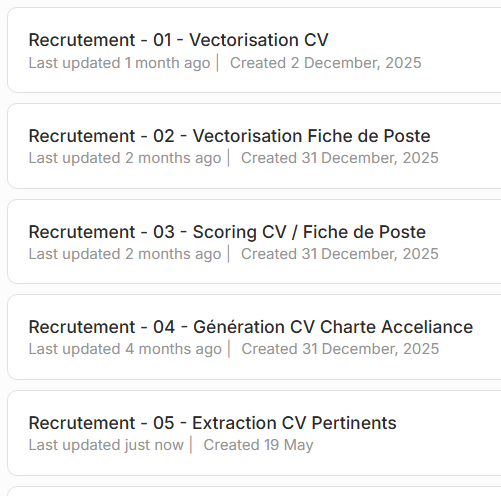
From the value chain to automatable workflows
The automated value chain translates into automated workflows:
-
CV acquisition and evaluation
-
Job Description acquisition
-
Scoring the CV against the Job Description
-
Identifying the relevant CVs for the Job Description

No automation without a knowledge repository
AI works by relying on input data. This data can be stored in the prompt if its size allows. When the size is too large, an external store such as RAG is required.
Point of attention: RAG inherently works on proximity statistics, which is another source of hallucinations.
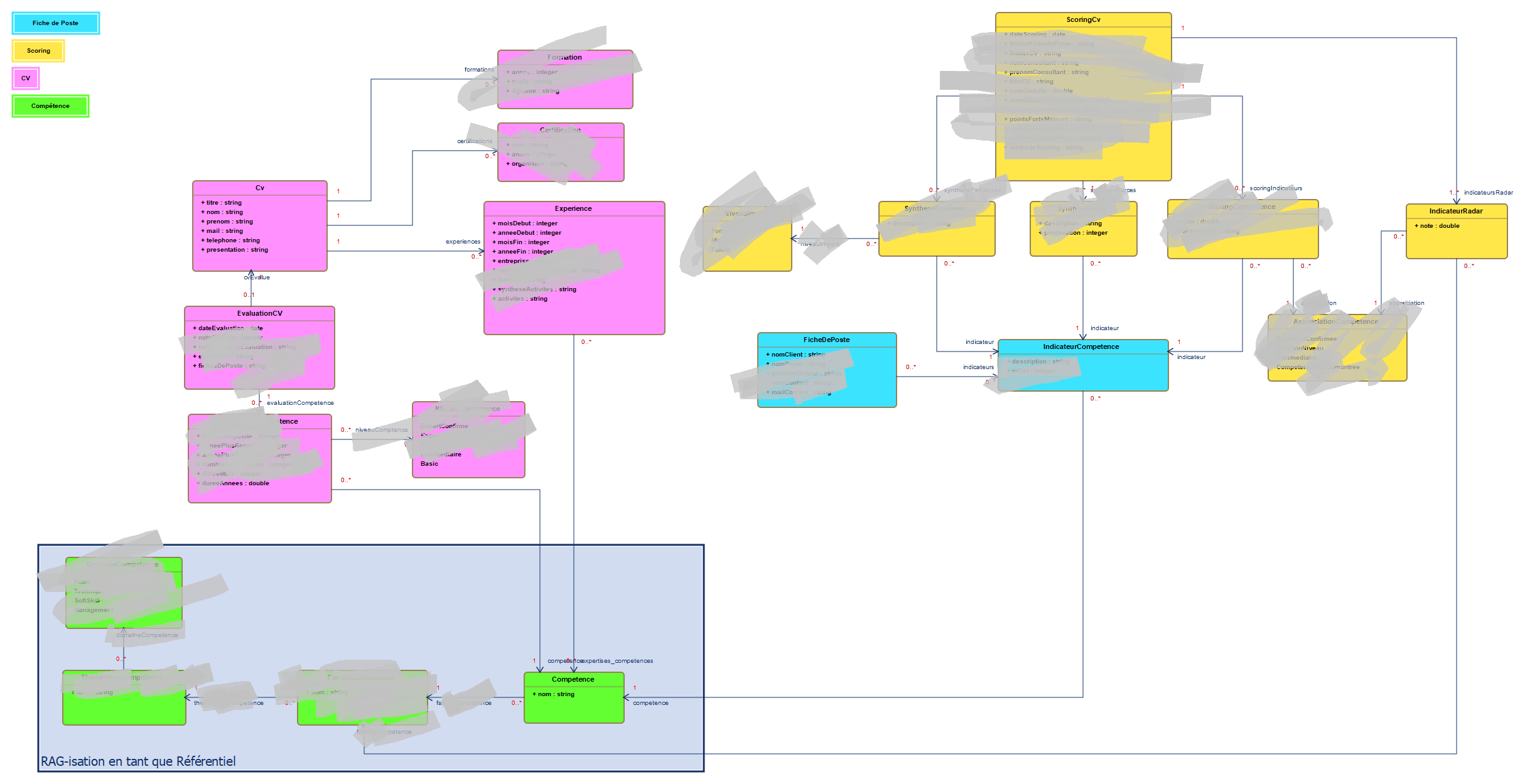
Building automation that is high-performing, predictable and free of hallucinations
The key to a successful AI implementation is the data model. It describes the entities, their relationships and cardinalities, and the data with their business definitions.
The model turns a system with random behavior into an intelligent system within the Enterprise's knowledge domain.
In this use case, the knowledge system turns out to be Skill-Centric.
Successful automation requires a structured approach centered on the Data Model, in order to anchor AI in the Enterprise's intelligence
Here, it standardizes the evaluation of applications to deliver consistent, traceable and reproducible scoring